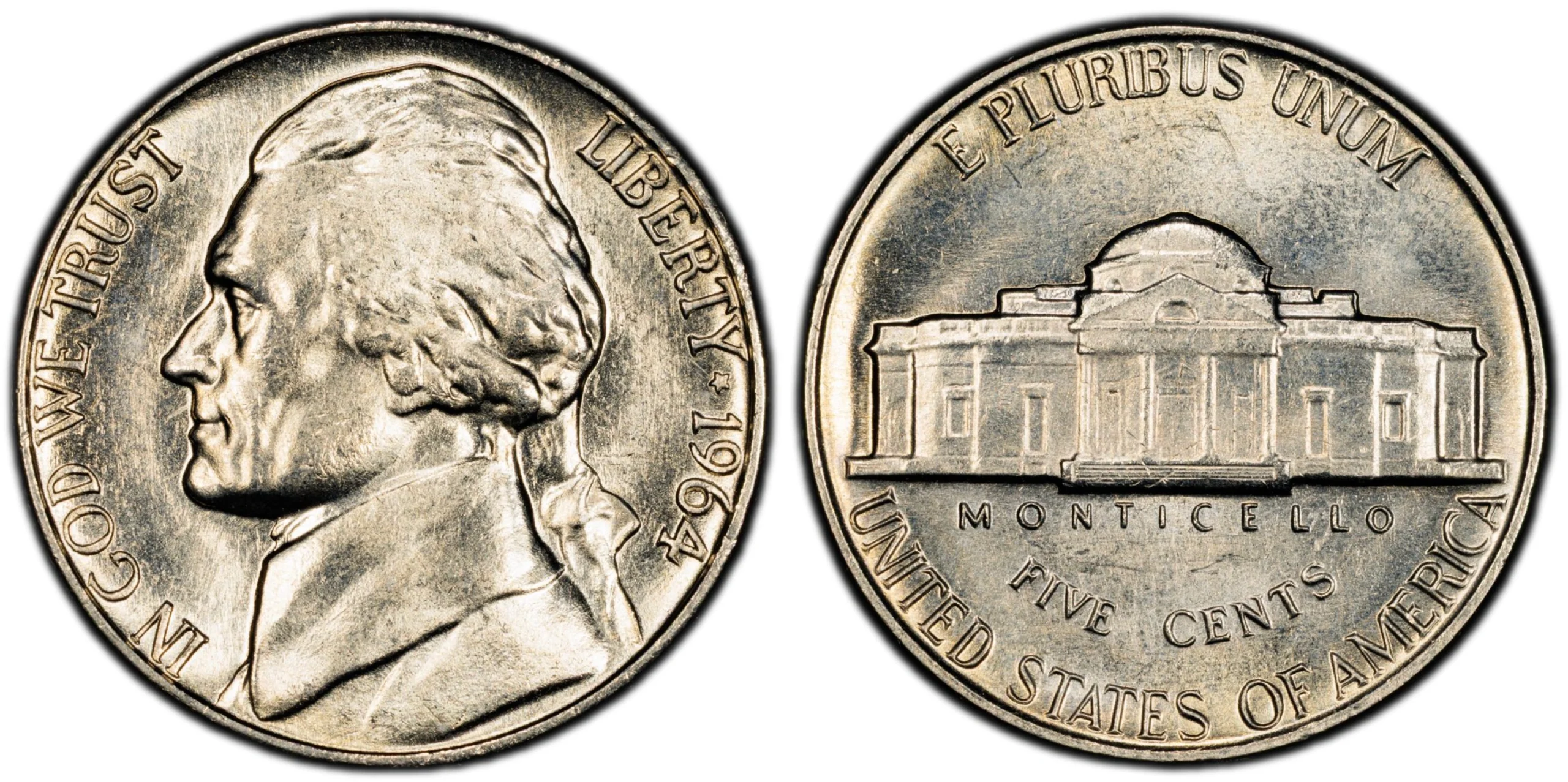
The 1964 nickel value starts from 5 cents and skyrockets to $100 for RPM and other major defect varieties. Always check rare item specifications and mint marks.
How Much is a Normal 1964 Nickel Worth?
Circulated Item Price – $0.05. Uncirculated Item Price – $0.25+.
Item Specifications
The total mintage over 2 billion coins. The item designer is Felix Schlag.
| Year | 1964 |
| Diameter | 21.20 mm |
| Weight | 5.00 g |
| Edge | Plain |
| Composition | 75 % Copper |
1964 Item Value Chart
The low prices for MS-60 and MS-62 grades of $0.25 to $1.00 indicate that thousands of pristine 1964 nickels survived the era. Collectors do not pay bonuses for these coins until they cross into MS-64 or higher.
| Grade | Philadelphia | Denver |
| MS-60 | $0.25 | $0.25 |
| MS-62 | $1.00 | $1.00 |
| MS-63 | $3.00 | $2.00 |
| MS-64 | $7.00 | $6.00 |
| MS-65 | $15.00 | $12.00 |
| MS-66 | $45.00 | $35.00 |
What is a 1964 SMS Nickel?
The single most valuable 1964 nickel did not originate from a regular production run. The U.S. mint created a small batch of prototype sets that numismatists now call the 1964 Special Mint Set SMS.
No official mint records document the origin of these coins, but experts believe Mint Director Eva Adams ordered their creation as experiments for a new type of collector set that eventually debuted in 1965.
Visual Identifiers of the 1964 SMS Variety
You can distinguish a 1964 SMS nickel from a standard coin through a close inspection of its physical features:
- Sharp details on Thomas Jefferson’s portrait
- Sharp details on the Monticello building
- Smooth, flat areas of the coin
- Square rims
Auction Records and Rarity
Numismatists estimate only 20 to 50 total sets of the 1964 SMS. These coins incite intense competition whenever they appear at public auctions.
Individual examples often set new price records, including a specimen that sold for $32,900 at Heritage Auctions. Look for coins featuring an incredibly sharp strike and a unique, smooth satin finish, which may indicate a historical 1964 SMS prototype.
Top Valuable 1964 Nickel Errors
| Error | Start Price |
| RPM | $20 |
| DDR/DDO | $50 |
| Striking Errors | $50 |
Look at coin-identifier.com, which can easily show the final error price and provide steps for better item identification.
1964 D Repunched Mint Mark (RPM)
The Denver Mint stamped a D on its coins in 1964 to indicate the origin of production. Workers struck this letter into the coin dies by hand with a steel punch. Sometimes, the worker struck the die twice because the first attempt did not line up correctly.
This error created the D Repunched Mint Mark. Under a standard magnifying glass or a loupe, you can see a clear second D shadow behind or beneath the main mint mark.
Value $20–$100
1964 Doubled Die Reverse (DDR) and Obverse (DDO)
A doubled die error happens when the hub transfers its image onto a coin die at a slightly different angle during the manufacturing process. The 1964 Jefferson nickel features several prominent doubled die varieties.
Value $50–$150
Striking Errors: Off-Center
Striking errors happen during the actual production process inside the coin press. An off-center strike occurs when the coin blanks do not sit properly between the upper and lower dies, which leaves a portion of the coin blank completely flat and crescent-shaped.
Value $50–$300
Clipped Planchets
A clipped planchet error happens when the cutting machine takes an irregular bite out of the metal strip before the strike.
Value $50–$100
Wrong Metals
A wrong metal error occurs when a 1964 nickel die strikes a dime blank or a foreign coin blank that accidentally fell into the machinery.
Value $10–$75
The Full Steps Designation
The major coin grading services, such as PCGS and NGC, use a special designation for exceptional Jefferson nickels known as Full Steps/FS. This term refers to the steps on the base of the Monticello building on the reverse side of the coin.
To qualify for this designation, a nickel must display five or six complete, horizontal lines across the entire staircase. The lines must remain entirely crisp and clear, without any mergers, scratches, or contact marks that break the steps.
Why Full Steps 1964 Nickels Are Extremely Rare
While the mint struck billions of nickels in 1964, it achieved very few clean strikes. The immense production goals meant that the mint workers used coin dies far past their normal lifespan.
As a die wore down, the details softened, and the steps on Monticello blurred into a smooth blob of metal. Because of this rushed production, a 1964 nickel with crisp, full steps represents a miracle of survival.
- MS-65 Full Steps Value $500
- MS-66 Full Steps $3,000
How To Determine If Your 1964 Nickel Is Rare
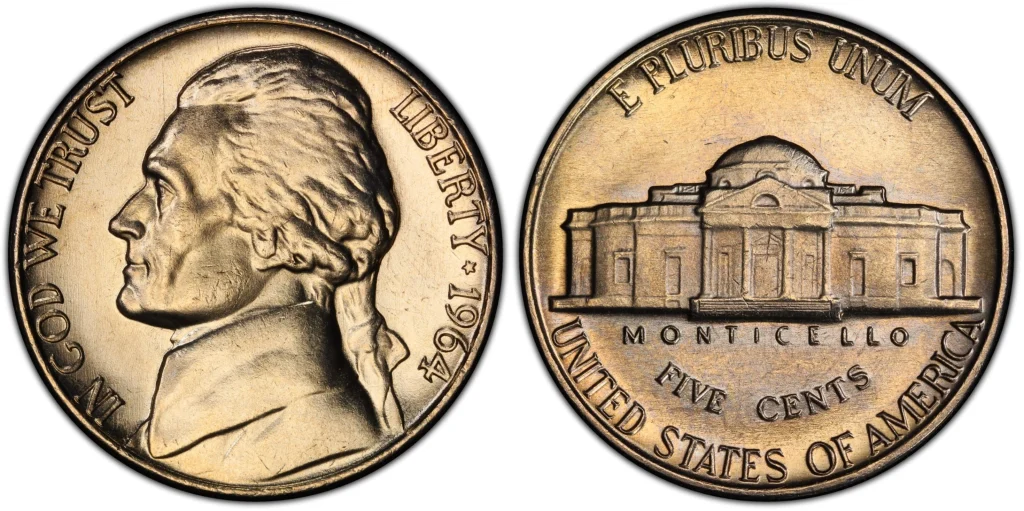
Step 1 – Check the Mint Mark Location
If you see a clear letter D, your coin came from the Denver Mint. If you see no letter at all in that space, your coin came from the Philadelphia Mint. Identifying the mint mark helps you locate the correct line on pricing charts and population reports.
Step 2 – Inspect Coin Condition and Luster
A mint-state coin will exhibit a spin of light across its surface, which collectors call the cartwheel effect. If the surface looks gray or shows tiny hairline scratches, someone likely cleaned the coin with a cloth or chemicals. Cleaning destroys the natural mint luster and removes all numismatic bonuses.
Step 3 – Send Your Nickel to PCGS or NGC for Grading
Professional authentication requires time and money, so you must select your candidates carefully. Do not send ordinary, worn 1964 nickels to grading companies. A certified grade from NGC verifies the authenticity of your coin and ensures you get the maximum value if you decide to sell.
Advantages of Collecting 1964 Rare Nickels
1. The Best Entry Point for Collectors
2. Strong Composition Items
3. Excellent Liquidity and Market Demand
There is a constant, steady demand for certified 1964 error coins, because millions of casual collectors are building Jefferson nickel sets. The items are easy to sell quickly through online platforms or major auction houses.